I'm happy, it's my first time.
I had previously been invited to
'Horizontes Latinos' and 'Perlak'
a couple times.
It was a very special process
because we sent this film
in a four chapter series format
And it was José Luis, your director,
who proposed to put it together
and make it a film.
Then, he invited us to the festival,
which was very nice to hear,
but I also realized that José Luis
had a clear picture in mind
—who knows the knowledge he holds—,
he was contemplating a movie in what
we had formulated as a series.
After putting it toghether,
—because we had to put it together—
I thought that he was rigth, of course.
So, I'm happy to be here.
I love the city.
I have also been here many times,
not just for the Festival.
It seems to me that
the Festival has grown a lot, with a wide international reach
that far exceeds that of our language.
I find that very interesting.
I've seen how the Festival developed
throughout the last ten years or so.
I don't know it because of what happens
at this festival, but because of what happens in others
with regard to this one.
From here it's harder to see
the impact that the film has outside of San Sebastian.
Since you're here, you're in a bubble,
like at any other festival.
But, when you're at other festivals,
or in other places where cinema is
discussed, talked about,
San Sebastián is present in conversations,
in what is said.
The films that are presented here
have an impact outside or after the Festival.
This means infuencing film culture and culture in general terms.
Real, tanggible culture.
This isn't a metaphor, it's not hope,
it's something that happens and that
I see now and have seen in recent years.
One of the things I value most about Netflix,
is that they gave us a little more time
than what's usual to film a series.
This allowed me to shoot it like a movie.
In the sense of moving the camera,
installing it, and taking the necessary time
for the scenes to flow in the way they are shot in films,
or in the way in which I think that movies should be made.
That's my point of view.
On the other hand,
what I think everyone is aware of is that,
in a movie theater —for obvious reasons—, you have,
in a way, the audience's full attention.
You are in a dark room
where action is happening collectively, in a huge screen,
with good quality sound,
There, a pizza will not arrive,
a WhatsApp text message will not arrive,
your doorbell will not ring,
your phone will not ring,
it will not darken nor will the sun go down...
Pure things that could scare me a lot.
So, in TV, the only thing you are a little more attentive to
is that I no longer have the full attention of the audience.
I know I'm going to be on a TV.
But at the same time,
there is a special circumstance in this film or series.
Both the original story and the material written by the screenwriter, Mariana,
involve the fact that what we are seeing and what is happening on screen
is conveyed through sounds whose source we cannot see.
Therefore, that's even more difficult on television.
So, we had to design it in such a way that most of the viewers
who are going to see the film
are going to do it on a television
and that the sound will come out from a TV.
Nowadays more and more people have soundbars
and have better sound. Hopefully that's the case.
We had to work on two fronts:
on the one hand, not compromising on the visual aspect of a film,
and on the other,
being very mindful that the viewer will be watching it on television.
And the interplay of sounds has to be clear to the viewer,
because otherwise, the story we’re telling gets lost.
The first thing was to be able to work
on Mariana's way, she's a writer that I admire a lot,
whose sentences become images and
who offers a very powerful visual aspect.
Ángela Poblete, who works with us,
found these stories before they were published.
So, we were able to read them.
I spoke to Mariana and proposed a way to put together the structure,
which in the end was to take one of the stories and,
from the others, take characters and arguments,
and bring them together in the story of "My Sad Dead”,
which is the central story.
Thus, she's fascinating, her work, her world...
How to bring that imaginary to the screen.
That's what matters to me.
I personally did it through two essential tools:
First is Emma, who stars Mercedes Morán.
the character, the actress,
and how to channel everything from her
and through her.
And then, as a more open memory exercise,
than being limited to political events
that occurred in Argentina or Chile, for example.
There comes a very nice lap, because I think
that we feel a little like owners of the memory.
Those of us who are still alive can remember, we can speak,
we can choose who to remember...
'I', 'I', 'I'...
There is a kind of egocentrism around the person
Mariana does something very nice,
as she opens up the possibility for the dead
to also claim their own memory, to say:
'I'm here, don't forget me, please’.
And that's a very nice thing.
We all have dead people nearby
and it's nice to think that they have emotions too
and that they want to be remembered.
Then, there is a dead person who comes
and knocks on the door and says:
'Here I am. Don't forget about me'.

 74SSIFF | We Are Naza Too
03:52
 74SSIFF | Weichen (Dust) - kafea
21:03
 74SSIFF | Body of Glass - kafea
22:27
 74SSIFF | El mal hijo - kafea
17:14
 74SSIFF | Esta soledad - kafea
22:45
 74SSIFF | La ilusión de un verano sin fin - kafea
20:26
 74SSIFF | Jaleos - kafea
28:25
 74SSIFF | Tender Loving Care - photocall
01:32
 74SSIFF | 5 minutos más - photocall
01:40
 74SSIFF | Heart of the Beast - photocall
01:48
 74SSIFF | 7h40 ce matin-là / Milo - photocall
01:17
 74SSIFF | El castillo - photocall
01:21
 74SSIFF | Jurado Oficial - photocall
00:59
 74SSIFF | Gala del cine vasco - alfombra
02:01
 74SSIFF | Brad Pitt - alfombra
02:28
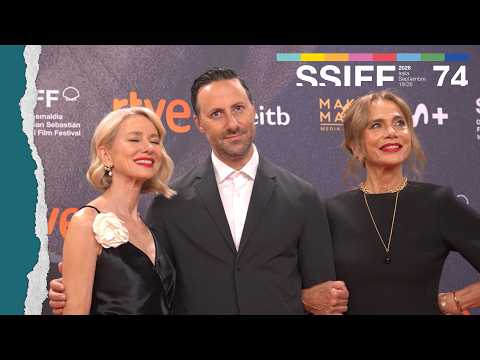 74SSIFF | Naomi Watts - alfombra
01:43
 74SSIFF | La bola negra - alfombra
02:33
 74SSIFF | Gala de Clausura - alfombra
01:17
 74SSIFF | Gala de Inauguración - alfombra
01:27
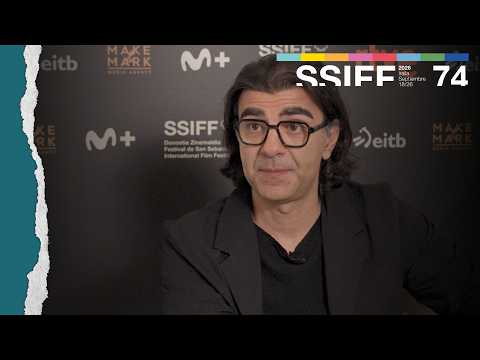 74SSIFF | Geister - entrevista
08:17