I read an anecdote about the release of the novel
I read an anecdote about the release of the novel
that people who could not afford the book
at the time of release contributed to it among friends or at
work and then lent it to each other.
And I thought that was pretty great.
To me, it was really the quintessence of the popular novel
and the popular work.
It's a book about people who don't have much money,
that is to say, about the poor, and, therefore,
they contributed to be able to read it
because it was about them.
It made me want to re-read the book
and, as soon as I started reading it,
I realized that there were a lot
of things that had never been adapted
about the characters, about their youth...
So, I said to myself:
'maybe there's an opportunity here not to remake existing adaptations,
but to show the audience other facets of the novel'.
And, then, I read the novel —during lockdown,
because the novel is 1700 pages long
and I needed a little bit of time to read it—and, in fact,
I found a lot of things that had never been adapted
and that made me want to embark on this new adaptation.
Namely, in French cinema there hasn't been
an adaptation for 40 years.
What’s quite funny is that we have one in 40 years of movies,
and there was one for TV or for musicals.
As the novel begins with this sentence:
'as long as there is ignorance and misery on this earth,
stories of the nature of this one will be worth telling'.
I have to adapt the words a little bit, but, unfortunately,
this story is still relevant today.
I jumped in at the deep end.
They say that the characteristic of great works
is that they are timeless,
that they stand the test of time and that they unfortunately
still speak to us very, very strongly today.
So I think that there is necessarily a political dimension,
So I think that there is necessarily a political dimension,
but also a mythological dimension.
That is to say, they are great figures that go through time
and today we see...
The treatment of misery.
There is this sentence that says
"There are no weeds, and no worthless men.
There are only bad farmers".
It's very very strong, you almost wonder where it comes from and,
in fact, it comes from "Les Misérables".
So when reading the novel, we come across sentences,
and then this dialogue between Javert and Valjean
which was a common thread between Javert and Valjean
on how to deal with what form should authority take,
how to deal with misery and the violence that results from it as well.
So, of course, it was very important
that we hear all the messages in
the film very loudly, but they can
be interpreted in many non-dogmatic ways.
This is not a moralizing film precisely.
That is to say, yes, there are the rich and the poor,
That is to say, yes, there are the rich and the poor,
but there are forms of violence.
How can misery lead to violence
How can misery lead to violence
and also how can wealth lead to violence?
At a time when everything is very polarized,
where populist formulas are appearing,
I think this film makes you think.
Its intelligence enlightens us a bit in a sometimes
slightly different era that is... Binary.
As I told you, I really wanted a choral movie.
To embody these characters, which are taken from a masterpiece,
I needed «maestros» at each location.
In addition, I think it feels like a real movie
when you see people like that, including stars.
When I was a child in France,
I would watch films, and I went to see Alain Delon
and Jean-Paul Belmondo together, which was already promising,
even in American cinema, with the film about the D-Day
or the conquest of the West.
There they were on this poster: John Wayne, Richard Whidmark...
Who I knew from before: 'Wow! I'm going to see stars'.
So, there was a bit of that and, before film stars,
they were brilliant actors.
Really, the movie owes them a lot.
Basically, there are Hugo's characters,
but what they bring to their characters,
whether it's Vincent Lindon in the monolithic side,
who embodies humanism without speaking...
That's a gift.
Tahar, who brings all the ambivalence to the character of Javert,
who we've seen all the time as the archetype of a villain,
is actually an unhappy child.
There is this duo of the Ténardiers,
which I changed a bit compared to the novel,
where it was really a two-headed hydra.
The husband admires his wife, and I found it ironic
that the day he decides to impress her — and when he succeeds
in impressing her for the first time in his life —,
he's going to kill everyone.
What we did with Fred was to be able
to continue to explore this character in the world of cinema.
It has been interpreted so much that what we are
It has been interpreted so much that what we are
trying to do with Fred is to bring a different Javert
so that we could explore in a different way.
And what could be frightening, when you read a work like this,
and when you see the mystery that surrounds Javert...
It is wonderful when you are a reader.
But when you suddenly become an actor,
if you are going to play, that fear finally becomes an advantage.
We talk to ourselves, we ask ourselves the question
of what can we do to explore and, precisely,
lift the veil a little on things and create
a character different from the others.
This is where we discover when we decide with Fred
to water this little seed that there is in the movie.
We talk very little about his mother,
we said to ourselves that we would develop this
to understand his trajectory,
to understand why a child like Javert becomes this iron rod,
to then commit suicide and his relationship with his mother,
abandonment, and everything that had happened around him.
The fact that he was haunted by it allowed us
not only to explain all this but also to give him empathy,
which was a challenge.
There is a lot of violence in the book,
especially on the part of Madame Thénardier,
where it is exerted on Cosette,
which, to be very honest, frightened me a bit.
After accepting the role, I said to myself:
After accepting the role, I said to myself:
‘but am I going to have to slap this kid?'.
Not for real, of course, but I was saying
that there were going to be repeated acts of violence,
like in the novel.
I discovered something about children of that time through Benjamin.
Victor Hugo called les Thénardiers like that in relation to Louis Philippe,
or something like that,
Thénard, who was a chemist and who was he,
they were both in the Chamber of Peers.
He, Victor Hugo, campaigned to really protect children,
to reduce the working time of children,
which amounted to one day's work.
The children worked 16 hours.
And so Victor Hugo was trying to reduce it.
Thénard was on the side of the industrialists, precisely,
and therefore he was absolutely opposed to that.
And so, there is one moment in the novel
in which Thénardier calls himself Thénard when he disguises
himself to try to coax Marius.
So the work was about childhood, child protection,
death, violence.
Things were not the same at all.
So the bodies, the relationship to the body was not the same.
So actually, we can't address that...
Yes, there is a thought about how we
are going to get into these bodies.
Modernise. That, I think, is an idea
that germinates in the director's head, in this case, Fred.
It was about modernising the thing.
I think that, because of its rhythm, the film has rhythms,
there is this hunt between Javert and Valjean
that reminds us a bit of "The Fugitive".
There is also this code of the western genre
that we have seen a lot in westerns and that is part of it.
It is this kind of duel that can happen in which one represents
the law, the other questions it.
They're just chasing each other until an obvious showdown happens.
I think that all this adds a lot to the modernity
of this adaptation.
But also, what makes it different from the other adaptations
is that it was a choral film where we also tell about the past
of the characters and we try to understand where they come from
and the reason why they become what they become.
I hadn't really seen that in the other adaptations.
Then there is the relationship with language.
That is to say, we are moving away from literature necessarily.
How does a book become a movie?
How should sentences be shortened?
How do we tackle the questions that arise...
In the middle, they are petty bourgeois, who are innkeepers.
How did they speak?
We were a bit overwhelmed.
That is to say, we are not historians
who know that exactly.
— I shot a movie that takes place at the court of Louis XV,
I played the king's first valet, and I don't know how
the vocabulary choices were made.
We are forced to let go of that a bit,
to desacralize or at least to reassure ourselves with the fact
that we may never live up to the truth.
So, we are the new misérables.
It's our bodies, our voices, our contemporaneity.
And, on the other hand, when it comes to the search of,
for example, hair, makeup or costumes,
there is a real research on materials, shapes and silhouette.
And that's great because the work of costume fittings
is also done for us.
It is a stage of transformation where we have the godillots,
the wide pants and we say to ourselves
that we have to believe in these innkeepers.
And Camille, I also watched her work a lot on how she held her spoon,
not like this, but like this.
How she drank her soup, how she secured her nails
with her little knife...
And so all these details are disconcerting
and we need to mind them too.
If we don't mind them, the public won't be able to believe it.
So we were ticking each other between takes,
we had a very kind eye and really a great deal of
confidence in our work.
And so, we were kind of safeguarding the speech,
the hustle and bustle.
If you ask me, well, don't let it be the Northern accent.
It's a kind of... popular.
Yes, anyway, I can't make it. It's impossible.
But well, anyway, I'm not completely myself either.
I don't know you that way.
You've never seen me like this.
It's not you at all.
No! But yes, there is a small cross-dressing nonetheless.
I think is wonderful about Hugo's novel is that the solution
to all this is fraternity and love.
It seems very naive to say that, but it is indeed,
again, a universal and timeless message.
Yes, everything resonates with the present:
this desire for change on the part of people
who have nothing and their disappointment with every revolution.
We believe in it and, unfortunately,
we are caught up in the reality of things.
Yes, there is melancholy and, at the same time, hope.
In the end, if you do good you are more likely to triumph
than if you do evil.
It's funny, when I say that, I tell myself that it's very naive,
but, in the world we live in, we're going to need
to go back to that naivety,
which is even vital.

 74SSIFF | We Are Naza Too
03:52
 74SSIFF | Weichen (Dust) - kafea
21:03
 74SSIFF | Body of Glass - kafea
22:27
 74SSIFF | El mal hijo - kafea
17:14
 74SSIFF | Esta soledad - kafea
22:45
 74SSIFF | La ilusión de un verano sin fin - kafea
20:26
 74SSIFF | Jaleos - kafea
28:25
 74SSIFF | Tender Loving Care - photocall
01:32
 74SSIFF | 5 minutos más - photocall
01:40
 74SSIFF | Heart of the Beast - photocall
01:48
 74SSIFF | 7h40 ce matin-là / Milo - photocall
01:17
 74SSIFF | El castillo - photocall
01:21
 74SSIFF | Jurado Oficial - photocall
00:59
 74SSIFF | Gala del cine vasco - alfombra
02:01
 74SSIFF | Brad Pitt - alfombra
02:28
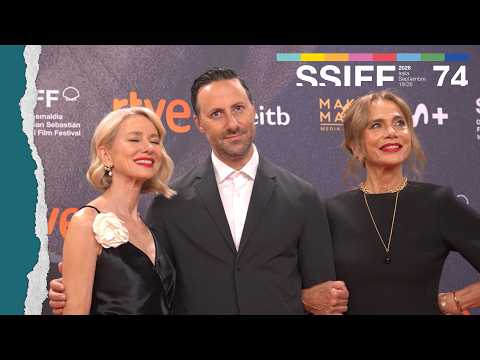 74SSIFF | Naomi Watts - alfombra
01:43
 74SSIFF | La bola negra - alfombra
02:33
 74SSIFF | Gala de Clausura - alfombra
01:17
 74SSIFF | Gala de Inauguración - alfombra
01:27
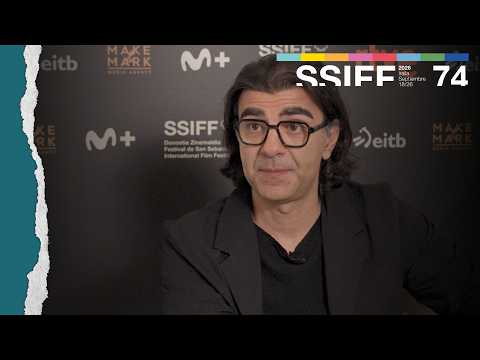 74SSIFF | Geister - entrevista
08:17