I was born and raised in this city, so I've said it many times.
I was born and raised in this city, so I've said it many times.
If I'm a filmmaker, it's thanks to the fact that once a year, all of a sudden,
films came to this city from all over the world, in all languages.
films came to this city from all over the world, in all languages.
We didn't live in a world as interconnected as now.
So it was an opportunity to see that cinema has many ways of seeing it.
I think that the spark of wanting to be a filmmaker also ignited here.
So, it's part of my emotional memory, of my memory as a filmmaker.
And then, of course, with “Suro” we kicked off a trip that was beautiful.
The film had an incredible reception here.
I feel it like home, but it turns out that home is an incredible place
to present the film to the world with an incredible projection. So I'm doubly happy.
I always start writing a story from a place, from a subjective impression
of a real place to find pure and hard fiction.
If in “Suro” it was the forests of the Empordà,
this time it was going to be the neighborhood where I live,
which is the Sants neighborhood of Barcelona.
I had the idea of finding fiction as soon as I opened the door of my house.
Then I started to interrogate the neighborhood from there.
It's an apparently familiar neighborhood.
Sants has a very strong associative fabric,
but it has a very religious name and you don't see that religiosity
in the neighborhood, apparently. So I said:
'Oh! And this name, where did it come from?'.
And I discovered that there is a church that gives the neighborhood its name.
So I wanted to go and see it and every time I passed by it
I found it closed. It's true that I didn't check the opening time,
but then one day I had this idea: a closed church is like a safe full of treasures.
Someone could steal them. In fact, churches or chapels
are often closed because there have been a lot of robberies.
Then I began to document myself on this issue of thefts of sacred art,
which is something that has been extensively documented.
And I found the historical figure of Erik, the Belgian,
who was a very prolific thief. And he spoke of the robberies almost
with a devotion to the art object. There's also certain mysticism
of being silent in those temples. That ambiguity interested me a lot.
So I created the character of Lali, the protagonist, who is a thief,
a drifter, someone who lives wandering around.
And I wrote a first scene that was like this:
this girl enters a hospital chapel, sits down, looks at the religious carving
and bursts into tears so much that the only person in the chapel feels the need
to leave the space because she wants to give her privacy.
'Something's wrong with this girl.'
As the door closed and that person left, Lali suddenly stopped her tears
like a super experienced actress, went straight towards the carving,
took it and stole it. That was all I had. And I started to pull that sequence.
I said: 'OK, this girl is in a hospital. Why is she in a hospital? Maybe someone is sick.
Maybe there's a sick mother. Are those tears just fake? Are they just lies?
Or is there a more personal intimate pain that is real?'
And that's where that layer of a daughter and a mother came from.
A mother who needs looking after. Maybe the idea of having to take care of somebody,
but not having decided internally if she wants to take care of somebody.
This what brought together the two layers of the film.
I really liked how entretaining the character was. It seemed like a story
that I would be interested in beacuse how it adresses looking after other people.
How we cope with family members who are in the latter stages of their lives.
I was drawn to how Mikel adressed this story in a very unique, very original,
and very undramatic way, while, at the same time, keeping the mystery,
and a rythm that I found really interesting.
Since Victoria and I have a very constant friendship,
I involved her in the project when I hadn't even finished the script yet.
We did improvisational meetings, generating material that I would then bring
to the script or not. We took a trip to the Bardenas desert,
where we meet the character in the film to give her a foundation.
What are those two talking about?
She’ll tell you when you’re ready.
Totally. Yes, well, a whole possibility opened up for the heist movie genre.
I also realized that, echoing what I read in the investigation,
the sequences of robberies are often filmed in a choreographic way
that almost has a sense of ritual. There is coordination, there is a secrecy,
there is almost a devotion to that piece that they want to remove.
A film that was also very important to us in that sense was “Irma VEP”
by Olivier Assayas. It's a 96 film that has this idea of reality,
but that suddenly moves to a more fictitious, higher place,
but in a very playful way. Ours was going to be a movie that was also going to be a game.
It talks about things that are deep and painful even,
but it has a point of escapism, like Lali. She is a person who lives on the run.

 74SSIFF | We Are Naza Too
03:52
 74SSIFF | Weichen (Dust) - kafea
21:03
 74SSIFF | Body of Glass - kafea
22:27
 74SSIFF | El mal hijo - kafea
17:14
 74SSIFF | Esta soledad - kafea
22:45
 74SSIFF | La ilusión de un verano sin fin - kafea
20:26
 74SSIFF | Jaleos - kafea
28:25
 74SSIFF | Tender Loving Care - photocall
01:32
 74SSIFF | 5 minutos más - photocall
01:40
 74SSIFF | Heart of the Beast - photocall
01:48
 74SSIFF | 7h40 ce matin-là / Milo - photocall
01:17
 74SSIFF | El castillo - photocall
01:21
 74SSIFF | Official Jury - photocall
00:59
 74SSIFF | Basque Film Gala - red carpet
02:01
 74SSIFF | Brad Pitt - red carpet
02:28
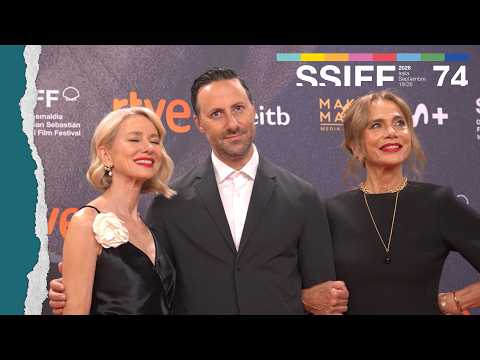 74SSIFF | Naomi Watts - red carpet
01:43
 74SSIFF | La bola negra - red carpet
02:33
 74SSIFF | Closing Ceremony - red carpet
01:17
 74SSIFF | Opening Ceremony - red carpet
01:27
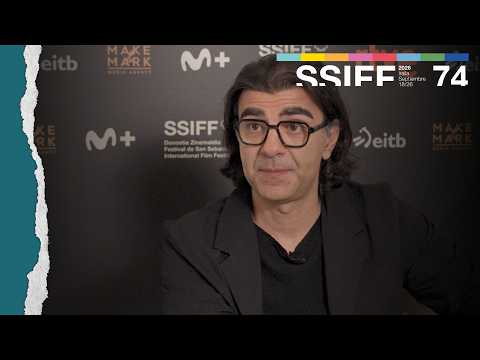 74SSIFF | Geister - interview
08:17